
Glider Piloting
Day 3

Clearing up some confusions
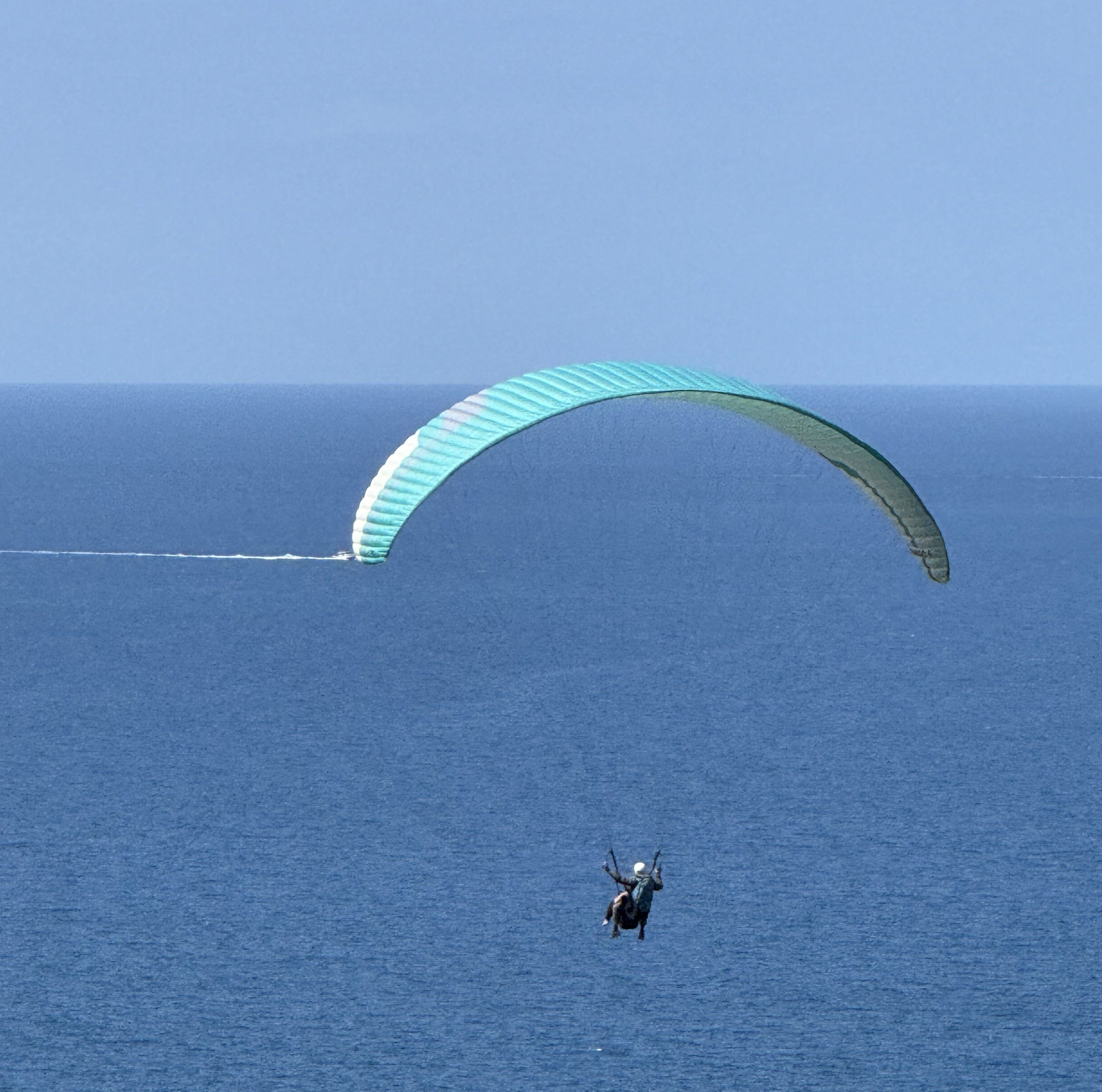
When most people hear the word “glider” they think of something gliding through air, like the paraglider pictured below, which sailed past the SWFSC facility while we were having our lunch break. Just to clarify, I am NOT in training to pilot any type of glider in the air, but rather autonomous vehicles in the ocean, which makes much more sense in terms of my work as an oceanographer. Today we didn’t have as much hands-on time with the gliders, and I didn’t take any pictures today during class, except for the one below taken during lunch break. And yes, I realize using this picture as the post cover is likely going to compound confusion!
Yesterday I talked about how changes to the glider’s buoyancy will propel it to dive or climb through the water. But I didn’t explain very well exactly how that happens. The glider we are working with has an oil bladder, which has two reservoirs - one inside the pressure sealed glider and one outside, exposed to the water. There is a motor in the glider that pumps oil in and out of the glider. To descend, oil will be extracted from the external reservoir into the interior of the glider, deflating the outside bladder, thereby decreasing the overall volume of the glider and making it more dense so it will sink. Likewise, once the glider has reached the desired depth (they can go down to 1000 m depth), the motor will push oil out of the glider, expanding the outside bladder, thereby increasing the overall volume of the glider and making it less dense so it will ascend. The total volume of oil is 840 cc, or a little bit more than a bottle of wine.
So what did we do today? Most of the day was spent discussing all the different files to keep track of things and to control things during a mission, ie operating the glider remotely when it is swimming about in the ocean. When the glider comes up to the surface it will extend an antenna to make a satellite communication connection. At those times (and those time only) the pilot can receive information from the glider about it’s location and how things are going on the glider. If any changes in the established mission need to be made, those commands can be sent to the glider at that point. After this brief communication rendez-vous the glider will resume its mission, which is basically to repeatedly descend and ascend through the water column, and take measurements, which are dictated by what sensors have been installed on the glider, all while navigating to the next desired waypoint. So most of the time that the glider is underway it is not possible to communicate with it. Which means that one has to maximize the communication when it is at the surface, and be very precise about the commands that are communicated to the glider. All of this communication is done via files which have all the commands explicitly stated. This is not piloting via a joystick!
At the end of the day we did do the final seal on the glider we have been practicing on. We got the glider to an overall density adequate to do a test dive in the test tank. And then for the final seal we removed all of the o-rings, cleaned them, inspected them for damage, lubricated them and reinstalled them. This part is critical because the o-rings are essential to preventing water intrusion into the pressurized compartments of the glider. Tomorrow we should be able to deploy the glider in the test tank and do a test dive with it.
I don’t have glider pictures from today, but I have some nice shots of the ocean. When I woke up this morning I could see the beautiful full moon from my hotel window. It only took me a few minutes to get down to the beach, but as soon as I got there the moon descended into a low cloud bank. But I got some nice shots regardless.


